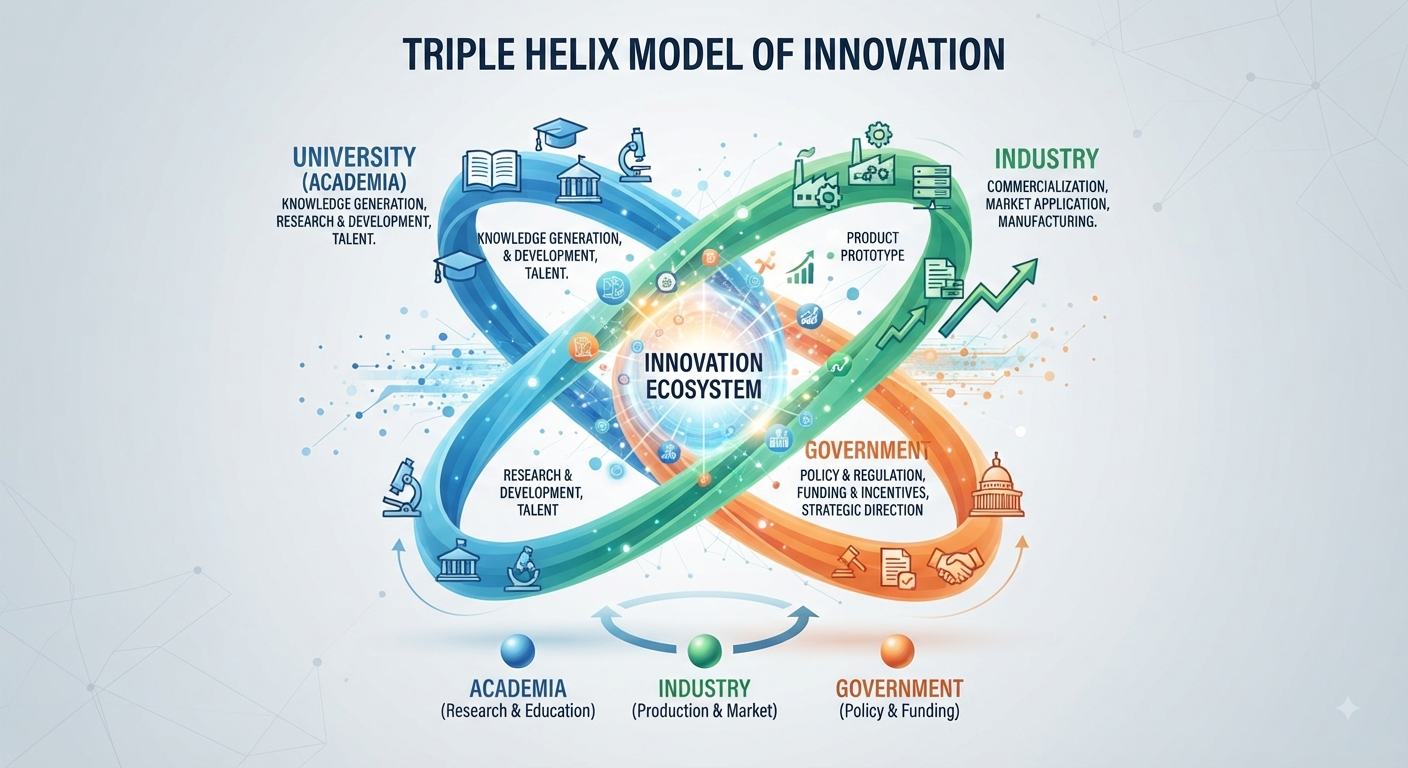
In an increasingly interconnected global economy, national growth is no longer driven by raw labor or isolated institutional efforts. Instead, true progress stems from a collaborative ecosystem where public policy, academic research, and commercial enterprise intersect. This collaborative framework is known as the Triple Helix Model of Innovation, originally conceptualized by Henry Etzkowitz and Loet Leydesdorff.
For a developing nation like Pakistan, adopting the Triple Helix model is not just an academic concept—it is an economic necessity.
Understanding the Triple Helix Model
The Triple Helix model conceptualizes innovation through the overlapping interactions of three core institutional spheres:
-
Universities (Academia): The primary engine for knowledge creation, basic research, and human capital development.
-
Industry: The locus of production, commercialization, market execution, and wealth generation.
-
Government: The facilitator and policy architect that provides regulatory frameworks, funding mechanisms, and infrastructural support to bridge gaps between the other two entities.
Unlike traditional linear models—where universities simply supply graduates, industry manufactures goods, and government regulates—the Triple Helix creates a dynamic network where each entity takes on aspects of the others, fostering hybrid organizations like Business Incubation Centers (BICs) and Offices of Research, Innovation, and Commercialization (ORICs).
How Pakistani Stakeholders Can Benefit
1. For the Government: Catalyst for Socio-Economic Stability
-
Evidence-Based Policymaking: By collaborating closely with universities, the government can draft policies rooted in empirical data rather than guesswork.
-
Optimized Public Spending: Directing grants toward targeted technological challenges ensures that national R&D funds yield high-impact commercial outcomes.
-
Job Creation & Export Diversification: Fostering high-tech startups helps shift Pakistan away from low-value exports toward a knowledge-based digital economy.
2. For Universities: Relevance, Revenue, and Real-World Impact
-
Commercialization of Research: Through frameworks like the Higher Education Commission's (HEC) Technology Development Fund (TDF), universities can move research out of lab shelves and into commercial markets.
-
Curriculum Alignment: Close interaction with industry leaders ensures that academic syllabi match market demands, drastically reducing graduate unemployment and skill gaps.
-
Financial Sustainability: Patent licensing, spin-off companies, and industry-sponsored labs provide alternative revenue streams for higher education institutions.
3. For Industry: Competitive Edge and Cost-Effective Innovation
-
Access to Cutting-Edge R&D: Local manufacturing and IT sectors often lack internal R&D budgets. Partnering with universities gives them access to state-of-the-art facilities and expert minds at a fraction of the cost.
-
Problem-Solving Hubs: Industries can tap into academic talent to solve intricate technical barriers, optimize supply chains, and automate production lines.
-
Talent Pipeline: Industries gain direct access to pre-vetted, highly skilled interns and graduates, lowering recruitment and training costs.
Moving Forward: Actionable Steps for Pakistan
To make the Triple Helix model a reality in Pakistan, several steps must be prioritized:
-
Strengthening ORICs and BICs: Universities must empower their research commercialization offices to act as proactive negotiators with local chambers of commerce.
-
Tax Incentives for Private R&D: The government should offer tax breaks or matching grants to Pakistani corporations that invest in university-led research initiatives.
-
National Innovation Portals: Expanding matchmaking platforms (like the HEC linkages portal) ensures seamless digital communication between factory floors and lecture halls.
Conclusion
The challenges facing Pakistan—ranging from energy constraints to agricultural inefficiencies—cannot be solved by any single sector working in isolation. By weaving together the strengths of academia, industry, and government through the Triple Helix model, Pakistan can unlock a resilient, innovation-driven future.